How Did William Levitt Help During the Baby Boom
Levittown isn't a unmarried edifice but a evolution of more than 17,000 discrete houses. The project – started in 1947 as America'south prototypical postwar planned community – has outlived its heartiest supporters and harshest detractors to stand today as something more complicated than a monument to the glory of the American dream, or to the blandness and conformity to which that dream led.
Similar so much else in 20th-century America, Levittown began as a shrewd business organization move. The homebuilding business firm of Levitt and Sons had specialised in upper center class dwellings on New York's Long Island before the second earth war, only to be curtailed by the conflict's enormous consumption of construction resources.
Just then the founder'due south son, William Levitt, came abode from the navy with an idea: every young veteran returning to the The states would need a abode. Couldn't the mass-production strategies he'd learned putting upwardly war machine housing give it to them?
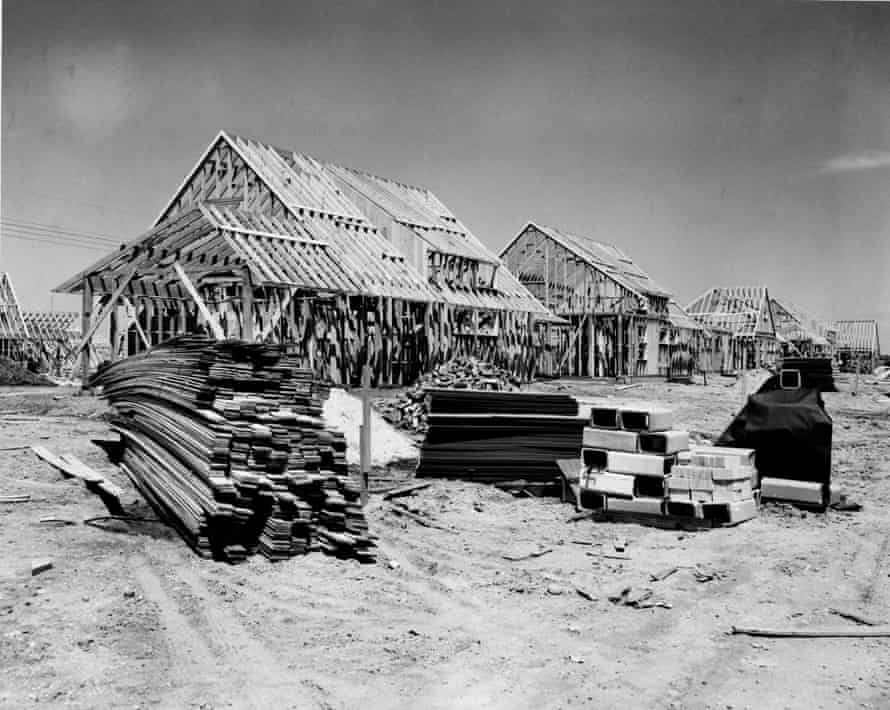
And so Levitt and Sons purchased a seven square mile tract of Long Island'due south potato and onion fields and got to piece of work, putting up all of Levittown's residences between 1947 and 1951.
Famously edifice one house every xvi minutes at the structure'south peak, using systems well-known in American automobile manufacturing just new to homebuilding. A diverseness of non-union subcontractors and "unskilled" workers moved from house to house, each performing one of 26 highly specialised steps in the overall associates process – all using thoroughly standardised materials, all purchased directly from their manufacturers.
"We are non builders," said straight-talking Levitt, the operation's mastermind. "We are manufacturers." He even went and then far equally to declare his company "the General Motors of the housing industry", providing families the domestic component of the American dream, just as GM provided them the vehicular one. And they did so with the same aesthetic uniformity every bit the auto industry in its early on years, initially stamping out house afterwards house on the same architectural plan, drawn upward by blood brother Alfred Levitt, albeit with subtle variations of colour, window treatment and roofline.
However, William Levitt called his product – which beginning sold for $seven,990 with a 5% down payment (0% for veterans) and came with a congenital-in goggle box and hi-fi – "the best house in the Us". But certain observers had grave reservations: Eric Larrabee in Harper'south mag called "the little Levitt business firm American suburbia reduced to its logical absurdity", and urban historian Lewis Mumford described the community they constituted as a "compatible surround from which escape is impossible".
Some sections of American society establish entrance to the scheme incommunicable. For decades, Levittown's population was 100% white – at first considering of covenants that restricted whatsoever minorities from buying in, and thus supposedly sending the surrounding home values into complimentary-fall. "The community has an almost antiseptic air," said an otherwise admiring 1950 Time magazine profile of Levitt and Levittown. Dark-brown v Board of Education and the nationwide racial integration that followed inappreciably touched Levittown, and even today its demographic profile all the same reads 94.xv% white.
By 1950, when 80% of Levittown's men commuted to jobs in Manhattan, the development had set an example for countless American sleeping accommodation communities still to come. They provided settings to the novelists who got their starting time in the mid-20th century, some of whom would famously inveigh against their stifling social atmosphere. Richard Yates, whose novel Revolutionary Route offers a harrowing indictment of American life during Levittown's heyday, wrote of that era'southward "full general animalism for conformity", a "blind, desperate clinging to safety and security at any price, as exemplified politically in the Eisenhower administration and the McCarthy witch hunts".
Levitt, for his part, assured the McCarthyites that "no one who owns his own house and lot tin can be a Communist. He has too much to practise." Though he built inexpensive, fully functioning houses and built them well – the vast majority of them still stand up today – Levitt left more or less everything else involved in the creation of Levittown to its new suburban homesteaders. Being American, later all, many of them set about customising their freshly built homes, whether of the standard utilitarian Greatcoat Cod design or the newer models (Colonial, Rancher and Country Clubber) that followed.
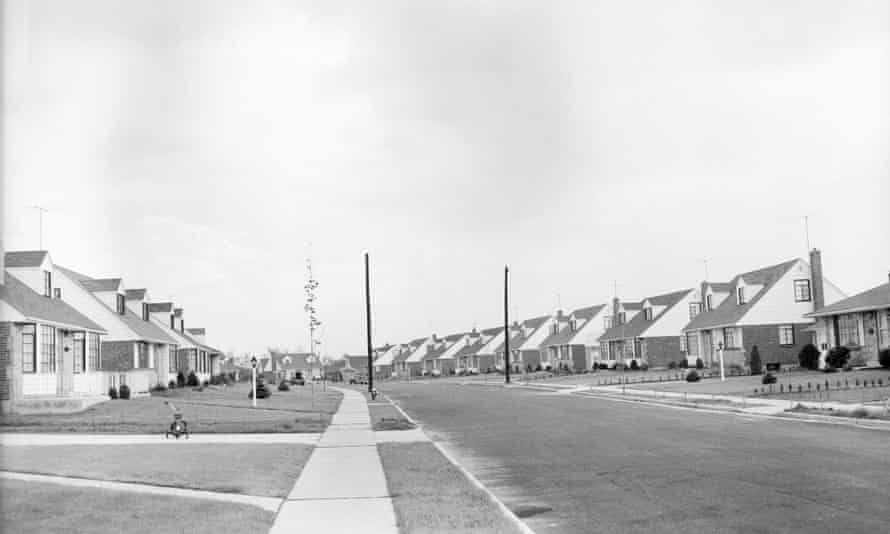
"Sure they were fiddling boxes when nosotros beginning started," says the narrator of WD Wetherell'southward short story The Man Who Loved Levittown. Just "the minute we got our mitts on them we started remodelling them, adding stuff, changing them around". He drifts into a rhapsodic recollection of "the 50s. The early 60s. We were all going the same direction … Cheers to Large Pecker Levitt we all had a take a chance. Y'all talk about dreams. Hell, we had ours. We had ours like nobody earlier or since ever had theirs. SEVEN Chiliad BUCKS! I HUNDRED DOLLARS Downwards! We were cowboys out at that place. We were the pioneers.'"
But this proud Levitt owner, looking back on what seems like a quintessentially American exercise in individualism, also remembers that "there wasn't anything nosotros wouldn't do for each other. Babysit, drive someone somewhere, mayhap help out with a mortgage payment someone couldn't run across." Non but did the first generation of Levittown life take its communitarian aspects, it had bodily regulations, such as Levitt'due south insistence that no homeowner fence off a individual yard from the shared light-green, that at present seem at least faintly socialist.
Levittown'south very existence, in fact, owes to a rare deed of American socialism: the 1948 Housing Neb, which loosened billions of dollars in credit and gave every American the take chances to get 1 of those v-percentage-down, 30-yr mortgages in the commencement identify. City-dwellers found that they could purchase their very own "modern" home but every bit hands as they could rent a walk-upwardly apartment, and homebuilders like Levitt found themselves in a booming business servicing a seemingly insatiable demand.
This government-sponsored encouragement of suburban residence – which, to an extent, continues to this day – did its role to reduce American downtowns in the second half of the 20th century to little more than collections of office buildings. Levittown and its descendants (three of which Levitt himself built in Pennsylvania, New Bailiwick of jersey, and Puerto Rico, all of which he also named Levittown) lured a generation out of the cities. Their children grew upward shaped by these secure and innovative if sometimes alienating environments – and went on themselves to heighten the generation that has fabricated a return, full-circumvolve, to the city.
How Did William Levitt Help During the Baby Boom
Source: https://www.theguardian.com/cities/2015/apr/28/levittown-america-prototypical-suburb-history-cities
0 Response to "How Did William Levitt Help During the Baby Boom"
Post a Comment